What does ‘medical-grade skincare’ actually mean?
The phrase sounds official, but “medical-grade skincare” is not a distinct FDA classification. The FDA regulates products based on intended use. A product intended only to cleanse or beautify is generally regulated as a cosmetic. A product intended to treat or prevent disease, or to affect the structure or function of the body, can be regulated as a drug or as both a drug and cosmetic.
The related term “cosmeceutical” also has no legal meaning under federal law. That matters because a premium package, clinic-only distribution model, or “medical-grade” label is not proof of FDA approval or superior efficacy.
So why do aesthetic practices use the term? Usually, they are referring to professionally selected product lines, targeted active ingredients, clinical testing, formulation quality, or products designed to integrate with procedures. Those can be real advantages, but the label itself is not the evidence.
Does that mean OTC skincare is just as good?
Sometimes, yes. Excellent cleansers, moisturizers, sunscreens, retinol products, acne treatments, and barrier-support products are sold over the counter. The American Academy of Dermatology emphasizes sunscreen and moisturizer as foundational anti-aging products, and neither needs a luxury medical label to work.
OTC can fall short when the product does not match the problem. A person with rosacea may keep buying stronger acids for “texture” and make redness worse. Someone with melasma may chase brightening serums without a diagnosis or consistent sun and visible-light protection. A client using five exfoliating products may interpret irritation as proof that the routine is active.
The comparison should not be clinic product versus drugstore product. It should be a thoughtful regimen versus a random collection of products.
Where provider-guided skincare can make a real difference
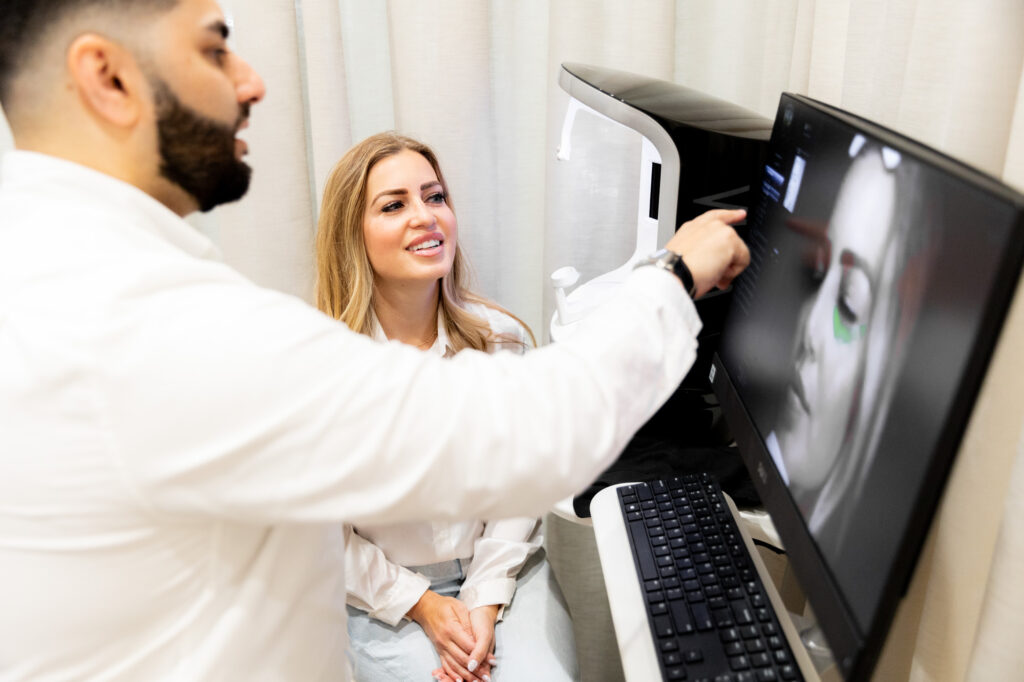
The first advantage is assessment. Renova uses VISIA skin analysis in facial consultations to look at features such as pigment, redness, pores, and texture more objectively. That can help separate a concern that looks similar in a mirror but has a different cause.
The second advantage is prioritization. Most people do not need ten active products. They need a cleanser that does not disrupt the barrier, a moisturizer appropriate for their skin, daily broad-spectrum sunscreen, and one or two targeted actives selected for a specific goal.
The third advantage is integration with procedures. A retinoid or acid that is useful during normal weeks may need to be paused before or after a peel, laser, or microneedling treatment. Professional guidance helps prevent an otherwise good product from being used at the wrong time.
What ingredients have the strongest track record?
Sunscreen is foundational. A broad-spectrum SPF 30 or higher helps reduce ongoing ultraviolet damage and protects the results of pigment, laser, peel, and anti-aging treatments. No brightening serum can outwork repeated unprotected UV exposure.
Retinoids are another major category. Prescription tretinoin is a drug with decades of evidence for acne and photoaging. OTC retinol and adapalene products can also be useful, depending on the indication. Strength should be matched to tolerance because irritation can worsen redness and post-inflammatory hyperpigmentation.
Vitamin C, alpha hydroxy acids, salicylic acid, niacinamide, pigment-modulating ingredients, peptides, growth-factor products, and barrier lipids can all have roles. The useful question is not whether an ingredient is trendy. It is whether the formulation, concentration, packaging, frequency, and total routine make sense for the individual.
Why concentration is not the whole story
Clients often assume a higher percentage is automatically more effective. That can be misleading. Formulation affects stability, penetration, pH, vehicle, tolerability, and how an active behaves with other ingredients.
Vitamin C is a good example. The form of vitamin C, concentration, pH, packaging, and exposure to light or air can affect stability. Retinoids differ in molecule and conversion steps. Acids behave differently depending on pH and buffering. A product with a smaller number on the front label can outperform a poorly formulated “maximum strength” competitor for a given person.
Tolerability also matters. A product that causes chronic irritation may lead the client to stop using it, and consistency is essential for most skincare outcomes. The best strength is the one that produces benefit without unnecessary barrier disruption.
When does OTC skincare truly fall short?
OTC products cannot solve every aesthetic or medical problem. Deep acne scars are structural changes in the dermis. Significant skin laxity involves tissue support. Dynamic wrinkles are driven by muscle activity. Established vascular redness may need a light-based or laser treatment. A suspicious pigmented lesion needs medical evaluation, not a brightening serum.
OTC can also fall short when a prescription treatment is indicated. Acne, rosacea, melasma, dermatitis, and other conditions may benefit from a medical diagnosis and prescription therapy. A med spa should know when to refer rather than simply selling a stronger cosmetic.
This is one reason Renova’s treatment menu includes skincare alongside BBL, MOXI, HALO, ProFractional, microneedling, injectables, and facials. The home routine maintains and supports skin health, while procedures can address targets that topical products cannot reach effectively.
How should skincare change around lasers and peels?
Procedure skincare should be simple and intentional. Before a laser or peel, Renova may ask clients to stop retinoids, exfoliating acids, benzoyl peroxide, scrubs, or other irritating actives for a defined period. After treatment, barrier support and sun protection take priority.
The exact instructions depend on the procedure. BBL does not have the same recovery as HALO. MOXI does not create the same wound profile as ProFractional. A chemical peel may also have different instructions depending on its depth and ingredients.
Do not copy a friend’s protocol or resume products because the skin “looks fine.” Microscopic barrier recovery can continue after obvious redness has resolved. Follow the written plan for the actual treatment you received.
Can medical-grade skincare replace procedures?
Usually not when the concern is structural. Skincare can improve hydration, brightness, mild pigment, acne, fine surface texture, and signs of photoaging. It can also protect procedure results and reduce recurrence of preventable damage.
It cannot reproduce the same tissue effect as fractional laser resurfacing, neuromodulator treatment, dermal filler, or RF microneedling. Creams do not create the same controlled thermal injury, muscle relaxation, volumization, or deep collagen remodeling.
The better strategy is to decide what should be handled at home and what requires an in-office modality. That prevents clients from overspending on products that were never capable of addressing the main concern.
What should a simple medical-grade routine look like?
A strong routine is often less complicated than social media suggests. In the morning, many clients need gentle cleansing, a targeted antioxidant or treatment serum if appropriate, moisturizer, and broad-spectrum sunscreen. At night, cleansing, a treatment active such as a retinoid when appropriate, and moisturizer may be enough.
Acne, pigment disorders, sensitive skin, or procedure preparation can require a different structure. Products should be introduced gradually so that the cause of irritation is identifiable.
Renova can use VISIA imaging and treatment history to build a routine around the actual concern. The objective is consistency and skin health, not the maximum number of steps on a bathroom shelf.
How do I shop for medical-grade skincare in Carmel?
Ask the provider why each product is being recommended, what active ingredient matters, how long it should take to evaluate, what side effects to watch for, and which products should be paused around procedures. A recommendation is more credible when the provider can also tell you what you do not need.
If you already have an OTC cleanser or sunscreen you love and it is working well, a good clinician may tell you to keep it. Provider-guided skincare does not require replacing everything at once.
For clients searching medical grade skincare Carmel, Renova Aesthetics offers skin consultation, VISIA analysis, facials, laser and light treatments, and home-care guidance. The value is not a label on a bottle. It is a plan in which every product has a reason to be there.
Frequently asked questions
Is medical-grade skincare FDA approved?
Not as a category. ‘Medical-grade skincare’ is an industry term, not a special FDA legal classification. Individual products may be regulated as cosmetics, over-the-counter drugs, prescription drugs, or other categories depending on their intended use and claims.
Is medical-grade skincare better than drugstore skincare?
Not automatically. Many effective sunscreens, moisturizers, retinol products, and acne treatments are sold over the counter. The advantage of provider-guided skincare is individualized product selection, evidence-based actives, procedure integration, and avoiding unnecessary irritation.
What skincare ingredient should everyone use?
Daily broad-spectrum sunscreen is foundational for most adults, especially anyone treating sun damage or investing in laser, peel, or anti-aging procedures. Product choice should still account for skin type and sensitivity.
Are prescription retinoids stronger than retinol?
Prescription tretinoin and other prescription retinoids are drugs with specific indications and evidence. OTC retinol is a different form of vitamin A and is generally less direct in its activity. Stronger is not always better if irritation prevents consistent use.
Can skincare fix acne scars or deep wrinkles?
Topical skincare can improve surface quality and some signs of photoaging, but deep acne scars, significant laxity, and dynamic wrinkles often require procedures or prescription treatment to create a meaningful change.
Where can I get medical-grade skincare guidance in Carmel, Indiana?
Renova Aesthetics in Carmel offers skin consultations, VISIA skin analysis, facials, laser and light treatments, and provider-guided home-care planning. The goal is to match products to your skin and in-office treatment plan.