PDGF under-eye treatment at Renova Aesthetics is not an injection. A concentrated topical growth-factor product is applied after a provider creates controlled microchannels with microneedling or ProFractional laser treatment. The goal is to support the skin’s recovery environment and improve the appearance of fine texture, dryness, and crepey skin over time.
What does “PDGF under eye” mean?
At Renova Aesthetics, “PDGF under eye” refers to a topical post-procedure step. PDGF is not injected into the under-eye area. A concentrated topical product is applied after microneedling, RF microneedling, or a precisely selected ProFractional laser treatment creates controlled microchannels in the skin.
This distinction matters because growth factors, injectable fillers, neuromodulators, and resurfacing treatments solve different problems. The under-eye area can show fine lines, thin or crepey texture, dehydration, pigment, visible vessels, hollowness, or puffiness. No single treatment addresses every cause.
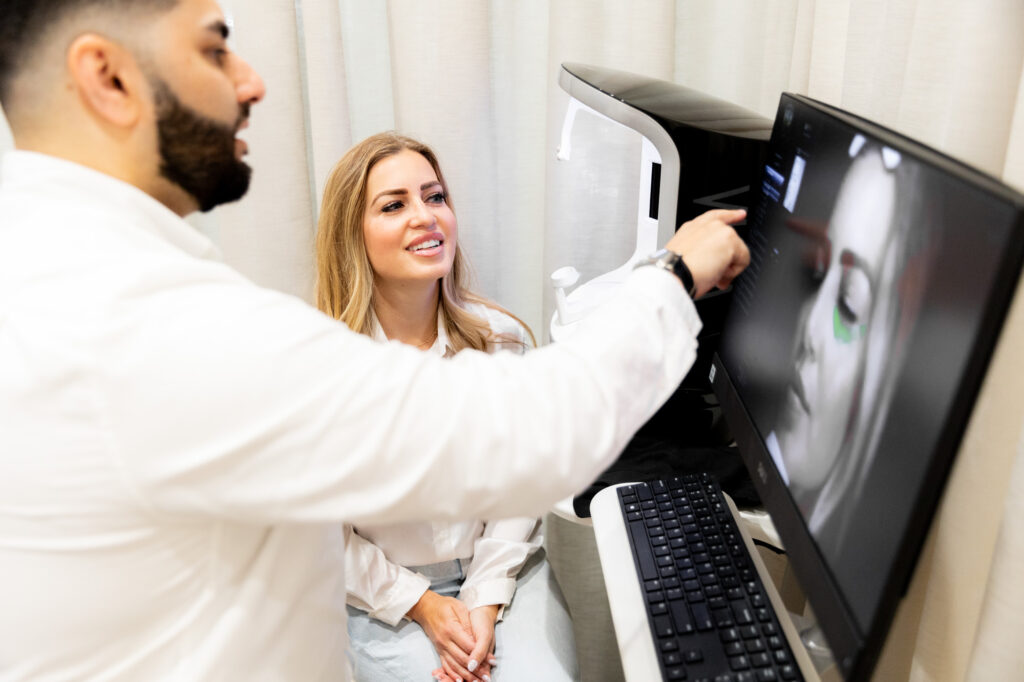
Renova Aesthetics is a physician-led medical aesthetics clinic in Carmel, Indiana. The team uses consultation, facial anatomy assessment, and VISIA skin analysis when appropriate to identify whether the concern is primarily texture, pigment, volume, movement, or a combination.
What is PDGF?
PDGF stands for platelet-derived growth factor. It is a signaling protein involved in normal tissue repair. In aesthetic skincare, laboratory-produced PDGF may be formulated as a purified topical concentrate designed for application to the skin, especially after procedures that temporarily create channels through the outer barrier.
The topical product does not add volume like a hyaluronic acid filler. It also does not relax a muscle like Dysport or Botox. Its intended role is to support cellular communication and the recovery environment while the underlying procedure stimulates skin renewal.
Early clinical research is encouraging. A 2025 randomized controlled study found that a topical recombinant PDGF product applied immediately after RF microneedling was associated with greater clinician-rated improvement at early follow-up and a better patient experience than RF microneedling alone. That study supports continued investigation, but it does not mean every under-eye concern will respond or that the treatment is equivalent to an injectable.
Why combine topical PDGF with microneedling?
Microneedling creates many controlled microchannels with fine needles. These micro-injuries initiate a wound-healing response that can support collagen and elastin remodeling. RF microneedling adds radiofrequency energy at selected depths to deliver controlled heat below the surface.
Applying topical PDGF immediately after treatment places the concentrate on freshly treated skin while the channels are open. The pairing is intended to support recovery and complement the collagen-remodeling process. The sequence is provider-directed: treatment first, topical application second.
For the delicate under-eye area, precision is essential. Skin is thinner, structures are closer to the surface, and overly aggressive treatment can create unnecessary risk. The provider adjusts device, depth, energy, passes, and treatment boundary to the person’s anatomy and skin quality.
Renova offers RF microneedling in Carmel and targeted options such as Exact RF microneedling. The appropriate platform depends on the concern and candidacy.
How can ProFractional be used around the eyes?
ProFractional is an ablative fractional laser treatment. Instead of removing the entire surface, it creates narrow treatment channels while leaving surrounding skin available to assist healing. Treatment depth and density can be customized.
When used by an experienced laser provider, ProFractional may be considered for fine lines, uneven texture, and crepey skin around the eyes. Topical PDGF can then be applied after the procedure as part of the post-treatment protocol.
Microneedling and ProFractional are not interchangeable. ProFractional uses laser energy and can create a more intensive resurfacing response. Microneedling uses needles, and RF microneedling combines needles with radiofrequency energy. Downtime, suitability, and expected change differ.
Renova is a leading Sciton provider in Indiana with advanced BBL HEROic, MOXI, HALO, and ProFractional technology. That breadth allows the team to choose a device because it fits the skin, not because it is the only tool available.
Which under-eye concerns may improve?
A topical PDGF plus microneedling or ProFractional plan may be considered for:
- Fine, etched lines
- Crepey or uneven surface texture
- Dry-looking skin that lacks resilience
- Mild textural changes related to sun exposure
- A desire to support recovery after a controlled resurfacing procedure
Results tend to be gradual because collagen remodeling takes time. The first visible change may be a smoother, more hydrated appearance after initial healing. Further improvement can develop over several weeks to months, depending on the procedure and treatment plan.
What does this combination not treat?
Clear expectations prevent disappointment.
Topical PDGF does not replace lost structural volume. If a deep tear trough or skeletal anatomy is creating a shadow, a resurfacing treatment may improve the skin but not remove the hollow. Filler may be considered for select candidates, although the under-eye area requires advanced assessment and is not appropriate for everyone.
PDGF also does not remove a fat pad, correct significant bags, or tighten severely lax tissue. Blue or purple discoloration from visible vessels is different from brown pigment. Fluid retention and allergies can contribute to puffiness. In some cases, a medical evaluation or surgical consultation is more appropriate.
A careful consultation separates the skin issue from the shadow, vessel, volume, or swelling issue.
What should you expect during treatment?
A typical appointment includes:
- Review of goals, history, medications, prior procedures, and eye-area concerns
- Examination of skin thickness, texture, pigment, laxity, and volume
- Photographs or VISIA analysis when useful for tracking
- Cleansing and topical numbing as appropriate
- Microneedling, RF microneedling, or ProFractional treatment using customized settings
- Immediate topical application of the PDGF concentrate
- Written aftercare and a follow-up plan
Clients may feel pressure, prickling, warmth, or brief discomfort during treatment. The eye itself is protected, and the treated boundary is selected carefully. Contact lenses, eye irritation, active infection, cold sores, recent procedures, and certain medications should be discussed beforehand.
What is recovery like?
Recovery depends more on the device and treatment intensity than on the topical PDGF.
After microneedling or RF microneedling, temporary redness, warmth, swelling, dryness, or sensitivity can occur. After ProFractional, redness, pinpoint crusting, peeling, and a longer period of visible healing may be expected. The under-eye area can swell more noticeably because the tissue is delicate.
Follow the clinic’s instructions rather than applying a long list of products. Typical guidance may include:
- Use only the approved gentle cleanser and moisturizer
- Avoid rubbing, picking, exfoliating, or applying strong actives
- Protect the area from sun and heat
- Delay makeup until the provider says the barrier is ready
- Avoid unapproved skincare on freshly treated skin
- Contact the clinic for increasing pain, blistering, drainage, vision changes, or worsening redness
The FDA issued a 2025 safety communication about serious complications reported with certain uses of RF microneedling, including burns, scarring, fat loss, nerve damage, and disfigurement. This reinforces the importance of a trained licensed professional, appropriate settings, careful anatomy, and a medically supervised practice.
How many treatments are needed?
The answer depends on the starting point, device, intensity, skin response, and goal. Some clients may choose one more intensive resurfacing session. Others may benefit from a series of gentler microneedling treatments spaced to allow recovery and remodeling.
Topical PDGF is an adjunct, not a shortcut. It may improve the treatment experience and support the recovery environment, but the underlying device, technique, home care, and time still drive the plan.
Renova’s STAX approach combines treatments strategically when the combination is likely to be more useful than a single service. The team also uses VISIA tracking when appropriate so decisions can be based on documented changes rather than memory alone.
Who should not receive treatment?
Treatment may need to be postponed or modified for active infection, open wounds, uncontrolled skin disease, recent tanning, significant immune suppression, impaired healing, certain medications, pregnancy, or a history of problematic scarring. Eye conditions, recent eye surgery, and prior under-eye filler should be disclosed.
Candidacy for RF microneedling or laser treatment is not determined by an online checklist. Skin type, pigment risk, anatomy, medical history, and the exact device all matter.
A precise plan for a delicate area
Searching “pdgf under eye” can make the treatment sound like a single product. In practice, the result depends on the full protocol. Renova Aesthetics in Carmel, IN evaluates the cause of the concern, selects microneedling or ProFractional when appropriate, and applies PDGF topically after treatment. A consultation can clarify whether texture-focused treatment is the right match for what you see.
Frequently asked questions
Is PDGF injected under the eyes?
No. At Renova Aesthetics, PDGF for the under-eye area is a topical concentrate applied after microneedling, RF microneedling, or ProFractional treatment. It is not injected.
What does topical PDGF do after microneedling?
Topical PDGF is intended to support the skin’s recovery environment and complement the collagen-remodeling response initiated by microneedling. Early research is promising, but results vary and the product is an adjunct to the procedure.
Can PDGF under-eye treatment replace filler?
No. Topical PDGF does not add structural volume. It may be considered for fine texture and crepey skin, while filler addresses selected volume concerns in appropriate candidates. Some hollows or bags are better managed with another option.
Is microneedling or ProFractional better under the eyes?
The better option depends on skin thickness, texture, pigment risk, downtime tolerance, and the degree of resurfacing needed. Microneedling is mechanical, RF microneedling adds controlled heat, and ProFractional is an ablative fractional laser.
How long is recovery after PDGF is applied?
PDGF itself is a topical post-procedure step. Recovery is determined mainly by the microneedling or ProFractional treatment. Redness, swelling, dryness, peeling, or pinpoint crusting may occur, with more downtime after stronger resurfacing.
Where is topical PDGF under-eye treatment available near Carmel, Indiana?
Renova Aesthetics in Carmel, Indiana offers topical PDGF as part of selected microneedling, RF microneedling, and laser resurfacing protocols after an individualized consultation.