What is ProFractional laser resurfacing?
ProFractional is an ablative fractional laser treatment built on an erbium:YAG 2940 nm platform. “Ablative” means the laser removes microscopic columns of tissue. “Fractional” means it treats only a fraction of the surface in a pattern, leaving intervening skin intact.
That combination is the core of the treatment. Full-field resurfacing removes a continuous layer across the treatment area. ProFractional creates narrow channels instead. The untreated tissue between those channels can participate in re-epithelialization and healing.
Sciton’s current technical information describes tunable ablation from superficial depths to as deep as 1500 microns, with independent adjustment of ablation depth and coagulation. A provider does not use maximum depth simply because it exists. Settings are selected for the indication, anatomical area, skin type, prior treatments, and acceptable downtime.
What does ProFractional treat?
ProFractional is often considered when the main problem is texture or dermal remodeling rather than only surface color. Sciton highlights acne scars and scar revision, fine to deep wrinkles, rough texture, pigmented lesions, and broader skin resurfacing.
Renova’s treatment page lists sun damage, hyperpigmentation, redness, fine lines, and wrinkles among concerns discussed for ProFractional. In practice, a consultation determines whether those concerns are better treated with ProFractional alone or with another modality.
For example, visible red vessels or widespread brown spots may be better addressed with BBL. Early tone and superficial texture may respond well to MOXI. A client with more significant acne scarring may need the deeper remodeling potential of an ablative fractional treatment. The diagnosis comes before the device.
How is ProFractional different from MOXI?
MOXI is a non-ablative fractional 1927 nm laser. It creates controlled microscopic treatment zones without physically ablating columns of tissue in the same way as ProFractional. This generally supports a lighter recovery profile and makes MOXI useful for early pigment, tone, and maintenance-focused goals.
ProFractional is ablative and can be taken deeper. That gives it a different role for scar remodeling, etched texture, and more significant resurfacing.
The choice is not “gentle versus good.” A lighter procedure can be exactly right when the concern is superficial. A deeper procedure is useful only when the additional tissue effect is justified by the problem and the client can follow the recovery plan.
How is ProFractional different from HALO?
HALO is a hybrid fractional laser. It delivers a non-ablative 1470 nm wavelength and an ablative 2940 nm wavelength in the same microscopic treatment zone. That allows a provider to address multiple layers in one hybrid treatment.
ProFractional focuses on tunable erbium ablation and coagulation. It can be customized for targeted resurfacing and scar work with precise control over depth.
Both are advanced Sciton technologies, and either may be appropriate depending on the concern. A client does not need to memorize wavelengths. The useful consultation question is whether the primary target is pigment, superficial tone, broad photoaging, scar architecture, deeper texture, or a combination.
How is ProFractional different from BBL?
BBL uses broadband light and is not an ablative resurfacing laser. It is often used to target visible pigment and vascular concerns such as brown spots and redness. ProFractional physically creates microscopic ablative channels for resurfacing and collagen remodeling.
This is why BBL and ProFractional can be complementary. One addresses selected chromophores, while the other remodels texture at controlled depths.
Renova is known for Sciton combination therapy and may sequence or combine modalities under a defined protocol. Combination treatment should still be individualized. More energy in one visit is not automatically better.
What happens during a ProFractional treatment?
The process begins with consultation, medical screening, and skin evaluation. Renova describes using a topical anesthetic for comfort before the laser treatment. Eye protection and device-specific safety measures are required.
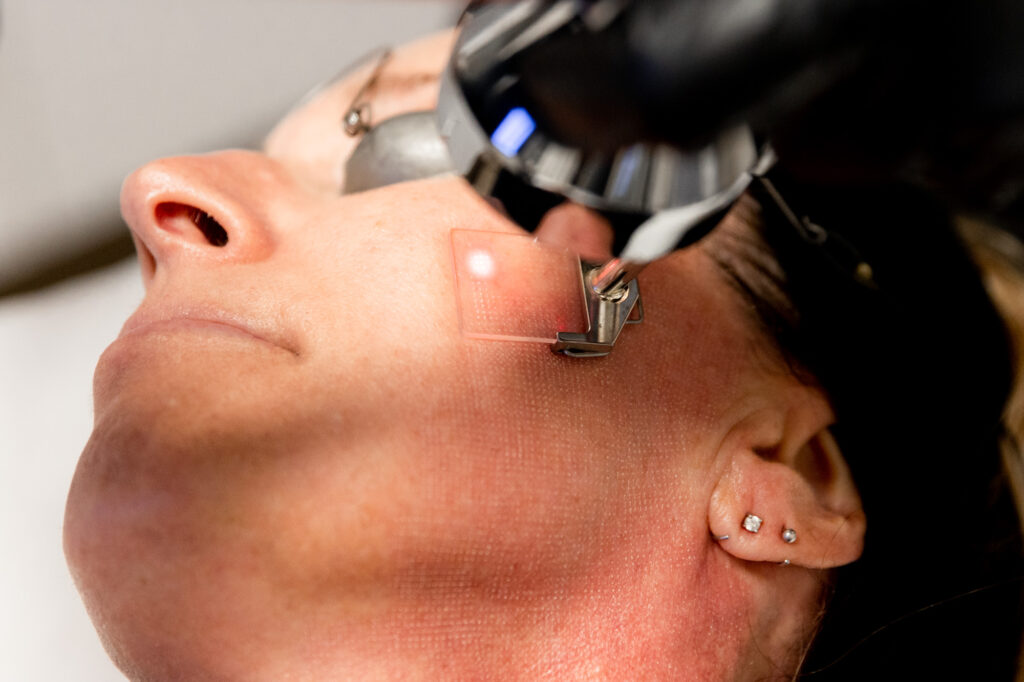
During treatment, the handpiece delivers a fractional pattern across the planned area. The provider selects depth, density, and coagulation according to the goal. A shallow pass for texture maintenance is not the same procedure as deeper scar-focused resurfacing, even when both are called ProFractional.
Treatment time on Renova’s current page is about 15 to 30 minutes, not including preparation and numbing. Larger areas, combination treatments, and individualized protocols can change the total appointment time.
What is ProFractional recovery like?
Renova lists about one week of recovery. Immediately after treatment, skin can be red, warm, swollen, and sensitive. Depending on treatment intensity, there may be pinpoint bleeding, oozing, crusting, peeling, or a bronzed appearance during early healing.
Aftercare is part of the procedure. Follow the exact cleansing, occlusive or moisturizing, and sun-protection protocol from the clinic. Do not pick flakes or crusts, exfoliate early, resume retinoids too quickly, or use a product simply because it is labeled “healing.”
Renova may also use provider-directed topical regenerative adjuncts such as PDGF concentrate or an exosome-based product after selected fractional procedures. These adjuncts should be described as optional components of a clinic protocol, not as substitutes for barrier care, infection precautions, sun avoidance, or medical follow-up.
When will I see results?
Early improvement can become visible as the skin heals and surface roughness resolves, but collagen remodeling takes longer. Texture and scar changes should be evaluated over weeks to months rather than judged on the first day the skin looks calm.
The number of treatments depends on the depth of the concern, intensity selected, prior procedures, skin type, and how much downtime a client can accept. Sciton notes that dramatic results may be possible after a single treatment, but that does not mean every indication or every client should be treated aggressively once.
Standardized photography is valuable. Renova can use consistent images and, when appropriate, VISIA analysis to track changes rather than relying only on daily mirror checks.
Who is a good candidate?
A good candidate has a concern that matches fractional ablative resurfacing and can follow post-care closely. Acne scars, selected surgical scars, deeper textural irregularity, photodamage, and wrinkles may lead to a ProFractional discussion.
Candidacy also depends on skin type, history of pigment change, tendency toward abnormal scarring, active infection, recent tanning, medications, immune status, cold sore history, and other medical factors. A history of melasma or post-inflammatory hyperpigmentation requires careful planning because inflammation itself can trigger pigment changes.
The provider may recommend a different technology or pre-treatment regimen when risk outweighs the expected benefit.
Why provider experience matters for deep resurfacing
Fractional erbium lasers are highly customizable. That is an advantage only when the person operating the device understands tissue response, laser physics, skin type, depth, density, coagulation, endpoint assessment, and aftercare.
Renova Aesthetics is an advanced Sciton provider in Indiana with BBL HEROic, MOXI, HALO, and ProFractional technology. Having several modalities allows the team to choose the tool for the target rather than forcing every concern into one device.
If you are considering a ProFractional laser, ask how the provider chooses depth, what recovery is expected for your settings, how pigment risk is managed, and what the clinic wants you to do if healing does not follow the expected course.
A practical next step
Bring your actual concern to the consultation, not just the device name. If acne scars are the problem, discuss scar type, previous treatments, and what degree of improvement would matter. If the concern is sun damage, ask whether BBL, MOXI, HALO, ProFractional, or a combination is the most efficient path.
Renova Aesthetics in Carmel, Indiana can build a plan around skin analysis, downtime tolerance, treatment history, and the depth of the concern. ProFractional can be a powerful resurfacing option, but the best result comes from choosing the right depth for the right problem and respecting the healing process.
Frequently asked questions
What is a ProFractional laser?
ProFractional is a fractionated 2940 nm erbium:YAG ablative laser from Sciton. It creates microscopic treatment channels at selected depths while leaving surrounding skin intact to support healing.
What does ProFractional treat?
It is commonly used for acne scars and other scar revision, fine to deeper wrinkles, rough texture, photoaging, and selected pigment concerns. A consultation determines whether it is the best device for the specific problem.
How much downtime is there after ProFractional?
Renova Aesthetics currently lists about one week of recovery. Actual downtime depends on depth, density, coagulation, treatment area, combination therapies, and individual healing.
Is ProFractional stronger than MOXI?
ProFractional is an ablative fractional treatment that can reach substantially deeper tissue, while MOXI is a non-ablative fractional 1927 nm laser generally used for lighter tone, pigment, and texture goals. Stronger is not always better; the correct depth depends on the concern.
Can ProFractional be combined with BBL?
Yes, under an appropriate provider protocol. BBL targets selected pigment and vascular concerns with broadband light, while ProFractional remodels texture through fractional ablation, so the two can address different components of photoaging.
Where can I get ProFractional laser treatment in Carmel, Indiana?
Renova Aesthetics in Carmel offers Sciton ProFractional within a physician-led practice that also uses BBL HEROic, MOXI, and HALO. A skin and laser consultation determines candidacy and treatment depth.